How to Measure Abdominal Girth
A step-by-step guide to measuring your abdominal circumference at home — the same way clinicians do it.
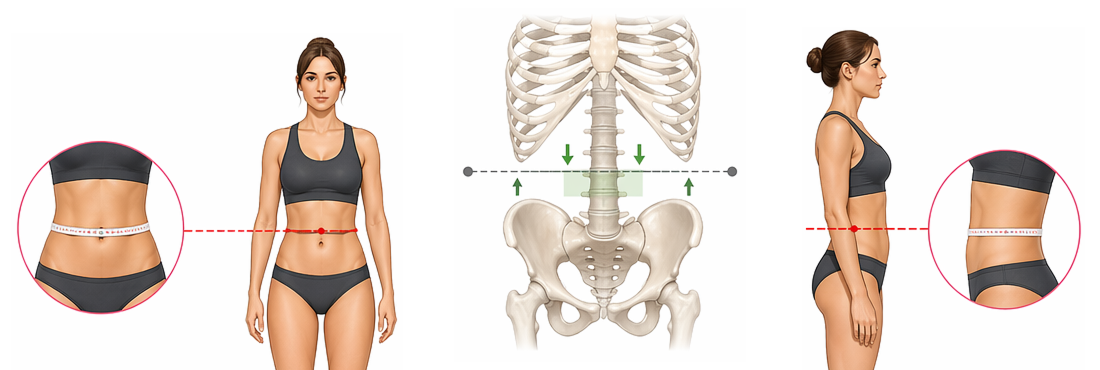
- 1
Strip the area
Remove or lift bulky clothing so the tape touches bare skin (or a thin layer). Heavy fabric adds centimeters that aren’t yours.
- 2
Stand naturally
Feet shoulder-width apart, weight evenly distributed, arms hanging at your sides. Don’t suck in or push out the abdomen.
- 3
Find the landmark
Place a finger on the bottom of your last rib and another on the top of your hip bone (iliac crest). The midpoint between them is where the tape goes — usually just above the belly button.
- 4
Wrap the tape
Pass the tape around the abdomen at that midpoint. Keep it horizontal and parallel to the floor all the way around — use a mirror or take a photo from the side to check.
- 5
Snug, not tight
The tape should touch the skin without compressing it. You should be able to slip a fingertip under it.
- 6
Breathe out, then read
Read the measurement at the end of a normal exhale (not a forced one). Record to the nearest 0.1 cm or 1/8 inch.
Got your number?
See what your waist circumference actually means
Plug your measurement into the calculator — we’ll classify cardiometabolic risk by sex and population, and tell you what to do with the result.
What you’ll need
- A flexible, non-stretchable measuring tape (cloth or fiberglass — not a metal builder’s tape).
- A mirror, or a friend, to check the tape stays horizontal.
- About 30 seconds. Best done first thing in the morning, before eating or drinking.
Common mistakes
Measuring at the belly button only
On many bodies the navel sits well below the true waist landmark. Use the midpoint between the lowest rib and the iliac crest instead.
Pulling the tape tight
A tight tape compresses skin and underestimates girth. Keep it snug enough to stay in place, no tighter.
Measuring over thick clothing
Sweaters and jeans add several centimeters. Measure over bare skin or a single thin layer.
Holding your breath
Inhaling expands the abdomen; forced exhale collapses it. Read at the end of a normal, relaxed exhale.
Letting the tape sag at the back
Without checking, the tape often slips down at the back. Use a mirror or take a side-on photo to verify.
This guide is for general education. For clinical assessment, talk to your clinician.