Waist-to-Hip Ratio
A two-tape-measure check on where your body stores fat — and one of the clearest signals of cardiometabolic risk, even when weight or BMI look normal.
What is waist-to-hip ratio?
Waist-to-hip ratio (WHR) is the ratio of waist circumference to hip circumference. It is widely used in clinical practice, fitness assessment, and preventive medicine as a marker of and .
The formula is simple: WHR = waist ÷ hip.
How to measure
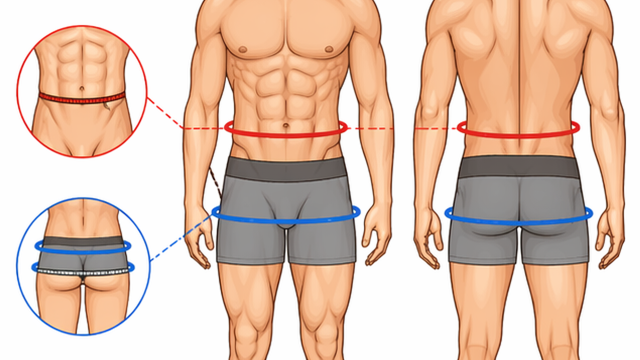
- Stand upright, feet shoulder-width apart, arms relaxed.
- Waist: locate the narrowest point between the lower costal margin and the iliac crest.
- Hip: locate the widest point over the buttocks.
- Wrap the tape horizontally around each landmark in turn.
- Measure at the end of a normal expiration; keep the tape snug, not compressing the skin.
- Record each measurement to the nearest 0.1 cm, then divide waist by hip.
Important
- Use a non-stretchable tape.
- Keep the tape parallel to the floor for both measurements.
- Take readings on bare skin or over thin clothing only.
- Use the same units for waist and hip — the ratio is unit-less.
For the waist part, see the full guide to measuring abdominal girth →
Why it matters
An elevated WHR is associated with increased risk of cardiovascular disease, metabolic dysfunction, , and impaired glucose tolerance. Because it normalizes waist size against hip size, WHR can flag risky fat distribution that a single waist measurement or BMI may miss.
Limitations
Waist-to-hip ratio cannot differentiate from . It also does not assess overall body composition such as total fat percentage or muscle mass.
WHR may be unreliable during pregnancy, in severe obesity (where excess subcutaneous fat distorts both measurements), or in patients with or . It is best interpreted alongside BMI, blood pressure, and metabolic markers.
FAQ
Visceral fat is metabolically active and strongly associated with cardiovascular disease, insulin resistance, and metabolic dysfunction. Waist-to-hip ratio helps estimate this high-risk fat distribution.
Yes. BMI estimates overall body mass, while WHR (and waist circumference) evaluate abdominal fat distribution. Combining both gives a more accurate cardiometabolic risk picture than either alone.
Yes. In severe obesity, both waist and hip measurements may be distorted by excess subcutaneous fat, and WHR becomes a less precise estimate of visceral fat.
Yes. Ascites, abdominal tumors, cysts, or organ enlargement can increase abdominal size independently of fat, leading to an overestimate of cardiometabolic risk.
No. Waist circumference is not reliable during pregnancy because abdominal enlargement reflects fetal growth, fluid changes, and physiological adaptations rather than fat distribution.
- Kułaga Z, Świąder-Leśniak A, Kotowska A, Litwin M. Population-based references for waist and hip circumferences, waist-to-hip and waist-to-height ratios for children and adolescents, and evaluation of their predictive ability. Eur J Pediatr. 2023;182:3217–3229.
- Martone AM, Levati E, Ciciariello F, Galluzzo V, Salini S, Calvani R, Marzetti E, Landi F. Impact of waist-to-hip and waist-to-height ratios on physical performance: insights from the Longevity Check-up 8+ project. 2025; Advance.
- Dobbelsteyn C, Joffres M, MacLean D, Flowerdew G. A comparative evaluation of waist circumference, waist-to-hip ratio and body mass index as indicators of cardiovascular risk factors. The Canadian Heart Health Surveys. Int J Obes. 2001;25(5):652–661.
- World Health Organization. Waist circumference and waist–hip ratio: report of a WHO expert consultation, Geneva, 8–11 December 2008. Published 2011.
- Cameron AJ, Romaniuk H, Orellana L, Dallongeville J, Dobson AJ, Drygas W, Ferrario M, Ferrieres J, Giampaoli S, Gianfagna F, et al. Combined influence of waist and hip circumference on risk of death in a large cohort of European and Australian adults. J Am Heart Assoc. 2020;9(13):e015189.
Waist-to-hip ratio is a screening tool, not a diagnostic test. Talk to your clinician for a personalized assessment.